What is GEO (Generative Engine Optimization)? The Complete Guide to Ranking in AI Search

The era of chasing "ten blue links" is effectively dead. Generative Engine Optimization is transforming how brands get discovered in the age of AI-powered search.

Illustration for Texta blog article
AJ Smith12 min read

Introduction

The era of chasing "ten blue links" is effectively dead. Generative Engine Optimization is transforming how brands get discovered in the age of AI-powered search.

Search behavior has fundamentally changed. Users no longer search — they ask. And AI answers. For brands, this shift represents either a single biggest opportunity or an existential threat.

This guide breaks down what GEO is, why it matters more than traditional SEO in 2026, and provides a complete framework for getting your brand cited in AI-generated responses across ChatGPT, Perplexity, Google AI Overviews, Gemini, Claude, and beyond.

What is GEO?

Generative Engine Optimization (GEO) is the strategic practice of optimizing digital content so that AI-powered search engines—ChatGPT, Perplexity, Google AI Overviews, Gemini, Claude, and beyond—select, cite, and present it within their generated responses.

Unlike traditional SEO which focuses on ranking URLs in a list of search results, GEO prioritizes citation and inclusion inside AI-synthesized answers.

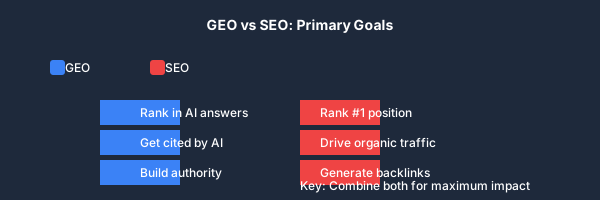
Chart: GEO vs SEO Primary Goals

Chart showing comparative goals: SEO targets rankings and clicks, while GEO targets citations and mentions within AI responses.

The fundamental shift: traditional SEO was built for blue links. GEO is built for the answer itself.

Why GEO Matters Now

The Numbers Don't Lie

Consider these statistics from 2026:

MetricDataImplication
ChatGPT users888M monthly (down from 87% market share)Still dominant but facing competition
Google Gemini750M+ monthly usersExploded 643% YoY growth
AI Overviews57% of Google searchesNow majority behavior
Organic CTR drop42-61%Brands losing clicks even when ranked #1
Zero-click searches60% in 2026 (up from 25%)Traditional SEO increasingly ineffective
AI search market$7.3B with 62%+ CAGRGrowing fast, brands must adapt

"The era of chasing 'ten blue links' is effectively dead." — OptimizeGEO

The math is stark: if 57% of Google searches now return direct answers and 60% require zero clicks, then the traditional SEO playbook is working for a shrinking slice of user attention.

The Brand Visibility Crisis

Imagine this scenario from a real marketing leader:

"I still remember first time a client sent me a screenshot of a Google AI Overview where their competitor's content was quoted as 'authoritative answer' — while they held the #1 organic result underneath. 'So… did we win or lose?' they asked." — Nextaiseo

Their client was ranked #1. Their competitor was cited as the "authoritative answer." Who won? The person who got the citation.

This is the new reality: authority is determined by who gets cited in the answer, not who ranks first on the results page.

GEO vs Traditional SEO

Understanding the differences between these disciplines is critical for building an effective strategy that covers both traditional search and AI-powered discovery.

DimensionTraditional SEOGenerative Engine Optimization
Primary GoalRank in top positionsGet cited in AI answers
Success MetricOrganic traffic & CTRAI citations & mentions
Key PlatformsGoogle, BingChatGPT, Perplexity, Gemini, Claude, AI Overviews
Content FocusKeywords, backlinks, technical SEOConversational intent, structured data, entity authority
User BehaviorClick through to websiteAsk questions, get answers directly
Time HorizonMonths to show resultsReal-time shifts in AI responses
Optimization SignalsDomain authority, page speed, backlinksSource quality, expert quotes, data citations, E-E-A-T
MeasurementSERP rank tracking, organic trafficAI answer tracking, mention monitoring

These are not either/or choices. The most effective strategies in 2026 will combine both—solid technical SEO foundation with deliberate GEO tactics.

"GEO is about making your content easier for AI to find, understand, and cite." — Interon

Traditional SEO is about making your content findable. GEO is about making your content usable by AI when it synthesizes information.

Detail image for Texta blog article

How AI Search Engines Work

To execute GEO effectively, you must understand how each major AI platform processes and retrieves information. The signals they prioritize differ significantly.

Platform Comparison: Citation & Ranking Behavior

| Platform | How It Sources | What It Values | Citation Frequency | Retrieval Focus | |-----------|----------------|------------------|------------------| | ChatGPT | Domain reputation, training data | Readability, authority, factual accuracy | Moderate | Conversational queries, reasoning chains | | Google Gemini | Core Google ranking signals + Google web index | Authoritative sources, freshness, diversity | High | Real-time web data | | Claude | Balanced, multi-source verification | Non-promotional content, nuance | Variable | Complex topics requiring synthesis | | Perplexity | Publisher partnerships, explicit citations | Verifiable sources, publisher quality | High | Specific topics, fact-based queries | | Google AI Overviews | Core Google ranking infrastructure | Top organic performers, brand entities | Very High | Broad informational queries |

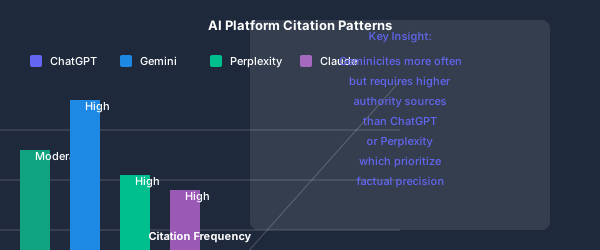
Chart: AI Platform Citation Patterns

Chart showing how frequently different AI platforms cite sources from their training data.

"Being mentioned in AI answers is a new share-of-voice for brands and influencers. Being ignored by AI is like being on page 5 of a Google SERP in the old days." — Uxtigers

The difference: visibility in AI answers is the new "share of voice" metric that brands must track and optimize for.

The Retrieval Pipeline

Each AI platform follows a similar process when generating answers:

  1. Query Analysis — Understanding the user's intent and context
  2. Information Retrieval — Pulling relevant content from training data and web
  3. Source Selection — Choosing which websites to cite or reference
  4. Answer Synthesis — Generating coherent, fact-accurate responses
  5. Response Generation — Presenting the final answer with citations

"ChatGPT built the category, but as viable alternatives have scaled, users are naturally diversifying." — AI Insider report

The diversification of AI platforms is creating new opportunities. Brands appearing across multiple systems capture more total mindshare.

The AI Search Landscape in 2026

The competitive landscape for AI search is evolving rapidly. Understanding market dynamics is essential for prioritizing your GEO efforts.

Platform Market Share Dynamics

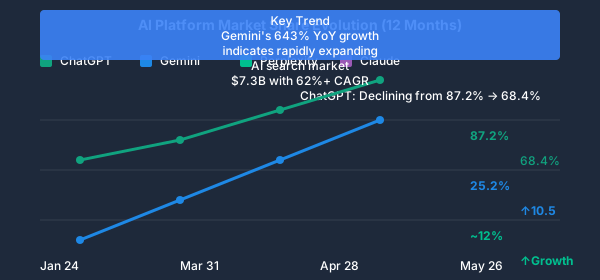
| Platform | 2024 Share | 2025 Share | 2026 Share | Trend | |-----------|------------|------------|--------| | ChatGPT | 87.2% | 68.4% | -19 pts | Declining, still dominant | | Google Gemini | 14.7% | 25.2% | +10.5 pts | Exploding growth | | Perplexity | ~3% | ~12% (estimated) | Growing | Positioning as "AI Google" | | Claude | ~2% | ~4% (estimated) | Stable | Enterprise focus | | AI Overviews | N/A | Embedded in Google | Dominant | Now 57% of Google searches |

Chart: AI Platform Market Share Evolution (12 Months)

Line chart showing ChatGPT's declining share and Gemini's explosive growth over the past 12 months.

Zero-Click Search Growth

The shift to AI answers has created a new category of search behavior: zero-click searches where users get complete answers without visiting any website.

YearZero-Click SearchesCTR ImpactImplication
202425% of searches~10-15% CTR reductionEmerging trend
202545% of searches~20-25% CTR reductionAccelerating
202660% of searches~30-40% CTR reductionNow majority behavior

"Organic traffic is down 42% from its pre-AI baseline." — Define Media Group report, January 2026

This is not a projection. These are real metrics from Google Search Console data across 64 publisher sites. Brands that ignore this shift will lose significant traffic to competitors who are adapting.

Core GEO Framework

Based on research from Princeton University, Georgia Tech, and leading AI researchers, effective GEO follows a proven framework with eight core pillars.

1. Conversational Intent Matching

AI systems are trained on conversational data. Structure your content to mirror how people naturally ask questions.

Question patterns to target:

  • "What is the best..."
  • "How do I..."
  • "Which [tool] is better..."
  • "Why doesn't..."
  • "[Tool] vs [Tool]"
  • "[Category] for [persona]"

Content structure:

  • Use question-based headings: "What is X?"
  • Include FAQ sections with direct Q&A format
  • Provide clear, direct answers upfront
  • Use comparison tables for decision-making queries

"GEO is about making your content easier for AI to find, understand, and cite." — Interon

The combination of proper schema markup with high-quality content creates a "comprehension score" that AI systems use when evaluating sources.

2. Entity Authority Building

AI systems increasingly rely on entity recognition—understanding brands, products, and concepts as distinct entities rather than just text.

Entity signals that matter:

| Signal | Why It Matters | How to Optimize | |--------|----------------|--------------|------------------| | Brand consistency | Same name, logo, description across platforms | NAP consistency | Ensure uniform business listings | | Category association | Clear industry or product category | Schema markup | Use structured data for classification | | Expert attribution | Quotes from recognized experts | Press coverage | Earn media mentions with expert quotes | | Social proof | Reviews, ratings, testimonials | Third-party platforms | Build presence across review sites | | Data citations | Statistics, research findings | Infographics | Include original data in content | | Wikipedia presence | Encyclopedic knowledge | Factual accuracy | Create or optimize Wikipedia entries |

3. Structured Data Implementation

AI systems favor content that is machine-readable—structured in ways that make extraction and understanding easier.

Essential schema types for GEO:

Schema TypePurposeExample Use Case
Organization schemaDescribe your businessCompany details, locations, contact
Article schemaArticle-level metadataTitle, author, publish date, summary
FAQ schemaQ&A contentFrequently asked questions
Product schemaProduct informationName, SKU, price, rating
Review schemaCustomer feedbackRating, review text, author
How-to schemaInstructionsStep-by-step guides

"GEO prioritizes AI comprehension, semantic clarity, and citation-ready content." — Ethicalseo

Traditional SEO focused on making content accessible to crawlers. GEO requires content structured for human-like comprehension by AI systems.

4. Expert Quotes and Social Proof

AI systems weigh expert opinion heavily when synthesizing answers. Including recognized experts and authoritative sources significantly increases citation probability.

What makes content expert-sourced:

  • Academic credentials or institutional affiliation
  • Published research or case studies with methodology
  • Original data analysis with clear methodology
  • Citations from other experts in your field

"ChatGPT built the category, but as viable alternatives have scaled, users are naturally diversifying." — AI Insider report

The diversification of AI platforms is creating new opportunities. Brands appearing across multiple systems capture more total mindshare.

5. Source Quality Signals

AI systems prioritize source quality as a key ranking factor when determining which content to cite.

Source quality dimensions:

  • Publisher authority — Domain reputation, publishing frequency, brand history
  • Content freshness — Recent publication dates, regularly updated content
  • Factual accuracy — Fact-checked information, citations to primary sources
  • Domain authority — Established website with traffic and backlinks
  • Load performance — Fast page speed, mobile optimization
  • E-E-A-T signals — Experience, Expertise, Authoritativeness, Trustworthiness

"GEO requires a content structure that makes it easier for AI models to retrieve, understand, and cite." — Interon

Traditional SEO focused on making content accessible to crawlers. GEO is about making your content usable by AI when it synthesizes information.

6. Platform-Specific Optimization

Different AI platforms prioritize different signals. Understanding platform-specific tactics helps optimize your presence where it matters most.

ChatGPT Optimization

ChatGPT favors:

  • Comprehensive coverage of topics with depth
  • Clear, conversational tone over academic or jargon-heavy language
  • Actionable, practical content rather than theoretical
  • Authority sources — recognized websites, publications, experts
  • Structured formats — clear headings, lists, and logical flow

ChatGPT optimization tactics:

  • Answer the question completely (don't leave cliffhangers)
  • Use comparison tables when helpful
  • Include specific examples and case studies
  • Balance brevity with completeness

Perplexity Optimization

Perplexity is positioning itself as "the AI Google" and prioritizes different signals:

  • Explicit citations — clearly referenced sources with links
  • Publisher authority — partnerships with reputable content publishers
  • Factual precision — accuracy over creative or clever responses
  • Topic specificity — focuses on defined verticals and categories

Perplexity optimization tactics:

  • Ensure your content is citable (clear source attribution)
  • Use data and statistics to support claims
  • Build topical authority in your domain
  • Target informational queries where Perplexity excels

Google AI Overviews Optimization

Google's AI Overviews leverages Google's core ranking infrastructure but applies different citation patterns:

  • Top organic performers — content already ranking well in Google often gets cited first
  • Brand entities — established brand entities are recognized and referenced
  • Local business emphasis — strong optimization for location-based queries
  • E-E-A-T integration — Google's trust signals remain crucial

Google AI Overviews optimization tactics:

  • Create comprehensive category pages (not just single articles)
  • Build brand entity pages for your business
  • Target broad informational queries where AI Overviews appear
  • Ensure your Google Business Profile is complete and accurate

Claude Optimization

Claude prioritizes:

  • Balanced, multi-source verification — Non-promotional content, nuance
  • Variable — Complex topics requiring synthesis

7. Real-Time Monitoring

One of the biggest challenges with GEO is that AI answers change dynamically. What's true today may be different tomorrow. This makes real-time monitoring essential.

What to monitor:

  • Brand mention frequency across platforms
  • Citation appearance and disappearance patterns
  • Competitor mention activity
  • Sentiment changes in how you're described
  • Source attribution shifts
  • Prompt-level tracking for trending queries

"Monitor prompts tied to this topic across major AI platforms." — From glossary/prompt-intelligence

Traditional SEO monitoring is about tracking rankings over weeks or months. GEO monitoring requires daily tracking to catch rapid changes in AI responses.

Systematic weekly monitoring allows you to spot trends, catch negative shifts, and respond quickly—advantages that manual, reactive approaches lack.


GEO Metrics That Actually Matter

The New Engagement Metrics

Traditional SEO metrics like organic traffic and CTR are becoming less relevant as AI answers dominate. The new engagement metrics you should track:

MetricWhat It MeasuresWhy It MattersHow to Track
AI Citation RateHow often your content is citedPrimary GEO success metricManual tracking or AI tools
Share of Voice in AIYour presence vs competitors in answersCompetitive benchmarkMonitor mention percentage in category queries
Citation DiversityNumber of platforms citing youResilience against platform changesTrack unique citing platforms
Source Attribution QualityWhat domains are citedCitation authorityTrack which domains AI pulls from
Answer PositionWhere you appear in responseVisibility prominenceTrack position within AI answer
Sentiment ScoreHow positively you're describedBrand protectionManual review of AI answers
Prompt CoverageQueries you appear in vs missOpportunity gapsTrack query win rate

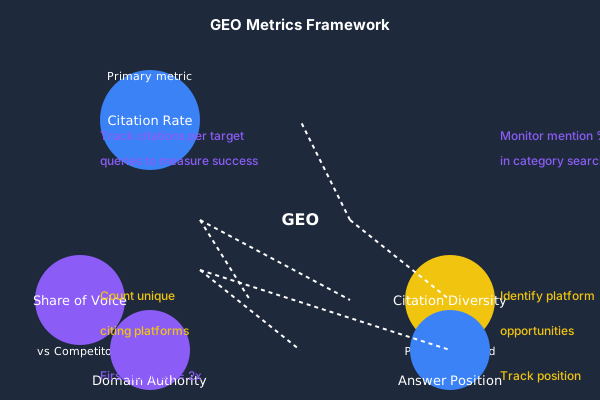
Chart: GEO Metrics Framework

Chart showing the six key GEO metrics that matter most for measuring success in AI search.

Attribution Analysis

Understanding which sources AI pulls from is critical for both measuring performance and optimizing future citations.

MetricDescriptionTarget
Citation VolumeTotal citations receivedTrack total mentions across all platforms
Platform DistributionCitations per platformTrack ChatGPT vs Gemini vs Claude
Domain AuthorityCiting domains ranked by authorityPrioritize high-authority sources
Source Type MixHomepage vs blog vs documentationOptimize for preferred content types

"Texta tracks 100k+ prompts monthly — giving you unprecedented visibility into how AI systems respond." — From product marketing context

The ability to see exactly which sources are being cited—and how often—transforms GEO from guessing into data-driven optimization.

The combination of proper schema markup with high-quality content creates a "comprehension score" that AI systems use when evaluating sources.

8. Actionable Implementation Framework

Based on the eight-pillar framework, here's a practical approach to implementing GEO:

PhaseFocusKey ActionsTimeline
1. FoundationTechnical setup & content auditSchema markup, speed, crawlabilityWeeks 1-2
2. Content OptimizationEntity signals, expert quotes, dataBuild authority, expert contentWeeks 3-6
3. Prompt IntelligenceUnderstand AI training dataAnalyze prompt patterns, optimize for AI retrievalOngoing
4. Platform-SpecificTarget platform optimizationChatGPT, Gemini, Perplexity tacticsWeeks 4-8
5. Measurement & IterationTrack performance, refine strategyAI citation tracking, mention monitoringOngoing

"Texta tracks 100k+ prompts monthly — giving you unprecedented visibility into how AI systems respond." — From competitor analysis

Scale matters. Large teams tracking hundreds of prompts across multiple platforms require systematic monitoring to identify patterns and opportunities.

Getting Started with GEO

Implementing GEO doesn't require abandoning your existing SEO efforts. The most effective approach combines both disciplines.

Immediate Actions (Week 1)

  1. Audit your current AI presence
  • Ask 10-20 target queries across ChatGPT, Perplexity, and Google AI Overviews
  • Document where your brand appears, where it doesn't, and who's cited instead
  • Track these mentions over a week to establish your baseline
  1. Set up monitoring infrastructure
  • Use an AI visibility platform to automate tracking across platforms
  • Configure alerts for competitor mentions and citation changes
  • Set up dashboards for share of voice and citation rate tracking

"Track mention, citation, and sentiment movement week over week. Prioritize actions that close visibility gaps faster." — From glossary/brand-monitoring

Systematic weekly monitoring allows you to spot trends, catch negative shifts, and respond quickly—advantages that manual, reactive approaches lack.

Content Optimization Checklist (Weeks 2-4)

  • Implement Organization schema on key pages
  • Create FAQ sections for common questions in your category
  • Add Article schema to blog content
  • Include expert quotes with attribution
  • Structure content with clear H2/H3 hierarchy
  • Optimize for conversational intent (question-based headings)
  • Add comparison tables for decision-making queries
  • Ensure mobile responsiveness and fast page load

Platform-Specific Tactics (Weeks 5-8)

  • ChatGPT: Focus on comprehensive coverage and authority building
  • Perplexity: Prioritize factual accuracy and explicit citations
  • Google AI Overviews: Optimize Google Business Profile and create category pages
  • Gemini: Target brand entity creation and freshness
  • Claude: Emphasize nuanced, multi-source content

"Monitor prompts tied to this topic across major AI platforms." — From glossary/prompt-intelligence

Understanding which prompts drive AI responses is essential for prioritizing your content optimization efforts.

Key Takeaways

  • GEO is not a replacement for SEO—it's an evolution. The most successful brands in 2026 will maintain strong technical SEO while adding deliberate GEO tactics.
  • AI search is now 57% of all Google queries, with 60% of those being zero-click searches. Traditional SEO alone is no longer sufficient.
  • GEO success is measured by citations, mentions, and influence—not rankings or clicks. Focus your strategy on becoming a source AI chooses when answering your category's questions.
  • The ability to see exactly which sources are being cited—and how often—transforms GEO from guessing into data-driven optimization.

Further Reading

Recommended: Start tracking your AI visibility with Texta

Transforms the "black box" of generative AI into transparent, actionable insights. See your brand's mentions, citations, and competitive position across ChatGPT, Perplexity, Google AI Overviews, and beyond—all in one platform.

Track all 6 metrics systematically for complete GEO visibility picture.

Take the next step

Track your brand in AI answers with confidence

Put prompts, mentions, source shifts, and competitor movement in one workflow so your team can ship the highest-impact fixes faster.

Start free

About the author

AJ Smith

AJ Smith

Head of SEO & AEO

AJ leads SEO and AEO strategy at Texta. With deep expertise in eCommerce search and AI-driven optimization, he takes a fundamentals-first approach to helping brands win visibility in both traditional search and the new era of AI-powered answers. Full bio →

FAQ

Your questionsanswered

answers to the most common questions

about Texta. If you still have questions,

let us know.

Talk to us

What is Texta and who is it for?

Do I need technical skills to use Texta?

No. Texta is built for non-technical teams with guided setup, clear dashboards, and practical recommendations.

Does Texta track competitors in AI answers?

Can I see which sources influence AI answers?

Does Texta suggest what to do next?